Water Depth at Mean Low Tide: How to Check It in St. Pete
Every canal listing says deep water. Here's how to check depth at mean low tide yourself, and why it matters more than the kitchen.

About the Author
Carly Majorana
Waterfront and luxury real estate specialist at NextHome Gulf Coast in St. Petersburg, Florida. CLHMS Guild Member. Specializing in the technical side of waterfront — seawalls, boat lifts, bridge clearance, and flood zones. Serving buyers and sellers in St. Pete Beach, Tierra Verde, Treasure Island, St. Petersburg, Bayway Isles, and Pinellas Point.
Every listing on a canal in Pinellas says the same thing. Deep water. Quick access. Bring your boat. And every listing agent, if you ask, will tell you your boat will be fine.
Some of them believe it. Some of them have never been on a boat. Almost none of them have stood on that dock with a measuring stick at dead low tide.
If they do admit the water gets skinny, you'll hear something like "sometimes you just have to wait a few minutes for the tide." Which sounds relaxing until you realize "a few minutes" can mean three hours, and "sometimes" means every winter cold front. With a bigger boat, that's not a quirk. That's the whole house.
Everyone Here Has Run Aground. Including Me.
I'm not saying this from some high horse. I'm saying it from a sandbar.
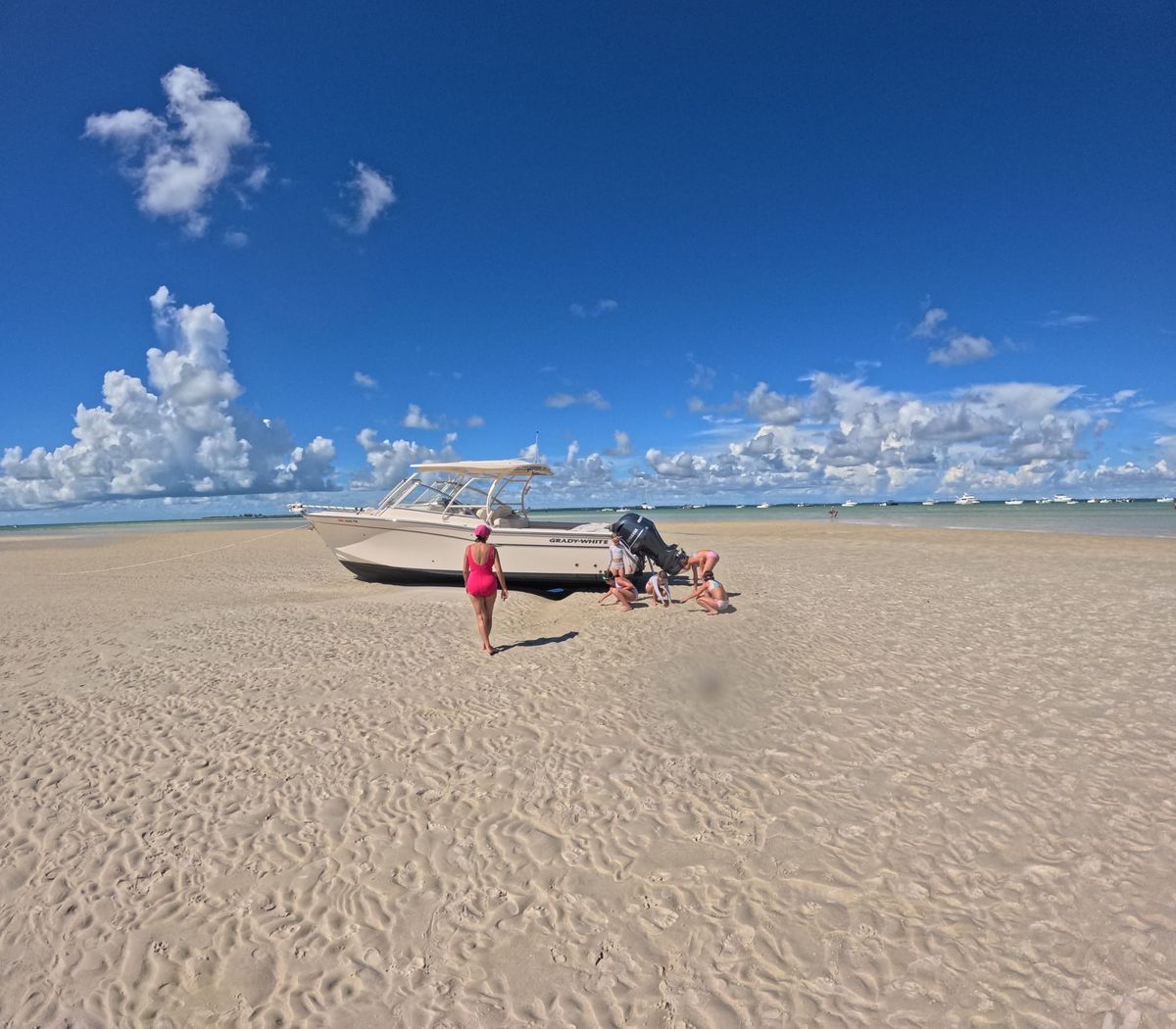
A few years ago we got a new boat. Different hull shape than our old one. We ran through a spot our old boat always cleared just fine, and parked it. About 500 yards from shore. For three hours.
And no, that is not our boat in the photo. We would never be that person.
We grilled hot dogs and waited for the tide to come back. It was actually a nice afternoon, because you're forced to relax when there's nothing else you can do. But I learned the lesson I now bring to every showing: depth isn't a feature of the water. It's a relationship between the water, the tide, and your specific boat. Change any one of those and the answer changes.
Now picture that same afternoon, except it's your own canal, you're trying to get home before a storm, and there are 25 more years on the mortgage.
What "Mean Low Tide" Actually Means
When someone says a canal is "6 feet deep," the only honest follow-up is: at what tide?
Tampa Bay tides aren't huge, but they're enough to matter. At NOAA's St. Petersburg station, the average swing between high and low is about 1.6 feet, and the gap between the average higher high and lower low is about 2.3 feet. So a canal that shows 5 feet when you tour it at high tide could be closer to 3 feet when it counts.
A few terms worth knowing:
- Mean Low Water (MLW): the average of all the low tides. This is what most people mean by "mean low tide."
- Mean Lower Low Water (MLLW): the average of the lower of the two daily lows. It's what nautical charts use as zero, and around here it sits roughly 4 to 5 inches below MLW.
- Negative tide: a low that drops below chart zero. Strong north winds behind winter fronts push water out of the bay, and those days are when you find out what your canal is really made of.
The number you want is depth at MLLW, and you want to know how much worse it gets on a blowout low. Anything else is a best-case number.
How Much Water Your Boat Really Needs
The spec sheet draft is the start, not the answer. Rough ranges for what I see on local lifts:
- Flats and bay boats: often well under 2 feet. They forgive a lot.
- 24 to 28 foot center consoles: roughly 1.5 to 2 feet at the hull, but closer to 2.5 feet with the engines down.
- 30 foot and up center consoles: about 2 feet at the hull and 3 feet or more once the lower units are down.
- Sportfish and inboard boats: often 3 to 5 feet, and you can't trim your way out of it.
Then add what the spec sheet leaves out. Fuel, gear, coolers, and six friends sit the boat lower. Hull shape changes how it behaves in skinny water (ask me how I know). And you need room under the props, not just under the hull, or you're chewing up the bottom and your lower units every time you leave.
A good starting point: take the boat's loaded draft with the engines down and add at least a foot at MLLW. More if the bottom is rock or oyster instead of soft sand.
How I Check Depth Before You Make an Offer
This isn't high tech. It's just the part nobody bothers to do.
- Measuring stick at the dock. I measure the actual depth right where the boat will sit.
- Tide chart open at the same time. I note where the tide is at that exact minute, then do the math back to low tide.
- If the numbers feel shaky, I go back at low tide. Usually the depth plus the tide chart tells me what I need. When it doesn't, I measure again when the water is actually low.
- Also check the route, not just the dock. Plenty of homes have 6 feet at the seawall and 2 feet at the canal mouth. Your boat has to get through the shallowest spot on the way out, not just float at home.
- What the neighbors keep on their lifts. A street full of flats boats is telling you something. So is a lone 36 footer that only moves on high tide.
- Silt and the last dredge. Canals fill in. Ask when it was last dredged and whether anything is planned.
Why Depth Is Worth More Than the Kitchen
You can redo a kitchen. You can add a bigger lift. You can even replace the seawall if you're willing to write the check. You can't move the bottom of the canal.
That's why two homes on the same street can sell for very different prices. The one with reliable water at low tide works for more boats, which means more buyers, which means a stronger resale. The one that needs a high tide to leave is a waterfront home with a schedule attached.
A canal that only works at high tide is like a gym that's only open two hours a day. Technically you have a membership.
Questions to Ask Before You Buy
- What's the depth at the dock at mean lower low water, not today?
- What's the shallowest spot between this dock and open water?
- What's the largest boat the current owner, or a neighbor, runs from this canal year round?
- Has the seller ever had to wait on the tide to leave or come home?
- When was the canal last dredged?
- Are there fixed bridges on the route, and what's the clearance at high tide? (Depth and clearance fight each other. Low tide hurts your hull, high tide hurts your T-top.)
FAQ: Water Depth at Mean Low Tide
What is mean low tide in real estate listings?
It usually refers to the average low tide depth at the dock or canal. The most useful version is depth at Mean Lower Low Water (MLLW), the average of the lowest daily tides, because that's closer to the worst normal conditions your boat will face.
How much do tides change in St. Petersburg, FL?
Not a lot, but enough to matter. NOAA's St. Petersburg station shows an average tide range of about 1.6 feet and about 2.3 feet between the average higher high and lower low. Winter cold fronts can push lows even further below average.
How can I check water depth at a waterfront home?
Measure off the dock with a measuring stick or a depth finder, note the exact tide level from a tide chart at that moment, and calculate back to low tide. If you're not confident in the math, measure again at an actual low tide. Then check the route to open water, not just the dock.
How much water depth do I need for my boat?
A good starting point is your boat's loaded draft with the engines down plus at least one foot at mean lower low water. Bay boats can get by with very little. Big center consoles and sportfish boats need a lot more room under the lower units or running gear.
Can a shallow canal be dredged?
Sometimes, but it involves permits, cost, and often neighbor coordination, and it isn't guaranteed. Buy the depth the canal has today, not the depth you hope it will have after a project nobody has approved yet.