Waterfront Insurance Cost St. Pete Beach: Real 2026 Numbers
Florida insurance rates went down this year, and an elevated waterfront home costs a lot less to insure than people think. Here are the real numbers, including mine.


About the Author
Carly Majorana
Waterfront and luxury real estate specialist at NextHome Gulf Coast in St. Petersburg, Florida. CLHMS Guild Member, specializing in the technical side of waterfront: seawalls, boat lifts, bridge clearance, and flood zones. Serving buyers and sellers in St. Pete Beach, Tierra Verde, Treasure Island, St. Petersburg, Bayway Isles, and Pinellas Point.
Every waterfront buyer asks me the same question, and it's never "how's the fishing." It's "what is insurance going to cost me?"
I wrote a post on this earlier in the year and, looking back, it dodged the question. It explained what moves the number. It didn't give you a number. So here's the version with actual dollars in it, including mine.
Two things are true right now that most people don't know. One: Florida homeowners insurance rates went down this year. Not "went up less." Down. Two: if a house is built to current FEMA elevation standards, the insurance is nowhere near as scary as the internet says it is.
Did Florida insurance really go down in 2026?
Yes. Here's the receipts, because I didn't believe it either.
- Citizens (the state-backed insurer) asked regulators for a 2.6% average cut for 2026. The Office of Insurance Regulation approved a bigger one: about an 8.8% average decrease on multi-peril policies and 5.5% on wind-only, effective July 1, 2026. Roughly 330,000 Citizens policyholders are getting a decrease, and over 150,000 of them are getting 10% or more.
- Private carriers filed cuts too. State Farm took 10% off statewide. Florida Peninsula about 8%. Security First 8%. Patriot Select 11.3%. Heritage 3.3%.
- Statewide, 44 insurers filed rate decreases for 2026 and another 48 filed flat. Rates dropped in 51 of 67 counties, Pinellas included.
- Seventeen new insurance companies have entered Florida since the 2022 reforms. More carriers fighting over your policy is the whole reason the number moves.
Why did it happen? The 2022 and 2023 tort reform laws cut way back on the lawsuit machine. Florida went from 79% of all U.S. homeowners insurance lawsuits in 2020 to 41% in 2025. Carriers also now have three years of real storm data, including Helene and Milton, so they can price the risk instead of guessing at it. Less guessing, lower rates.
Is it a massive drop on any one house? No. Eight to ten percent on a policy is real money, but it's not going to change whether you can afford the house. What it does change is the direction. For five years every renewal was a punch in the face. This year, for a lot of people, it wasn't.
What does insurance cost on an elevated waterfront home?
I'll use my own house because I actually know the numbers.
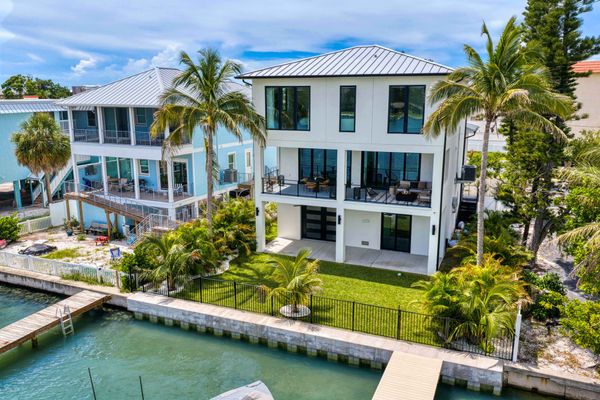
I live on Treasure Island in a new build that's elevated to current FEMA standards. It recently appraised at $2.4 million. Here's what I pay:
- Homeowners (including wind): about $4,500 a year.
- Flood: about $5,500 a year.
Call it $10,000 a year, all in, on a $2.4M waterfront house. That's about 0.4% of the value. People assume a house like this costs $30,000 or $40,000 a year to insure. It doesn't, if it's built right.
Now the part that matters. Take that same $2.4 million and put it into a 1970s block house sitting at ground level in an AE zone, the kind that's been remodeled three times but never lifted. The flood policy alone can run into five figures, and depending on the age of the roof and the electrical, the wind policy might too. Same street. Same water. Completely different bill. I wrote about why that happens in why waterfront homes on the same street sell for different prices.
Why is an elevated home so much cheaper to insure?
Flood insurance is priced on how likely water is to get inside your living space. If your living space is 12 feet in the air, water has a hard time getting there.
A few things the insurance companies actually reward:
- Height above base flood elevation. Under the NFIP's current pricing (Risk Rating 2.0), every foot above the base flood elevation trims the premium. Agents I work with put it at roughly 10 to 20% per foot, which stacks up fast.
- Nothing but parking and storage below the flood line. A garage with flood vents is fine. A downstairs "bonus room" with drywall and a mini split is not, and the flood policy will treat it like living space.
- A current elevation certificate. This is the document that proves the height. No certificate, no discount. I covered it in elevation certificates for waterfront homes in St. Pete.
- New construction. New roof, new electrical, new plumbing, impact windows, and a wind mitigation report that checks every box. That's why my wind number is what it is on a house this size.
The short version: insurance companies price the house, not the view. A new elevated house on the water can be cheaper to insure than an old ground-level house three blocks inland.
What if the house isn't elevated?
Then you need to know the numbers before you write the offer, not after inspections.
Here's what I do on every non-elevated waterfront house before my buyers commit:
- Get the seller's current flood policy and declarations page. If it's an older NFIP policy, ask if it's assumable. That can be the difference between a $3,000 flood bill and a $12,000 one, because a transferred policy keeps its rate path instead of starting over at the full-risk price.
- Get the elevation certificate. If there isn't one, order it during inspections. It's a few hundred dollars and it decides the flood quote.
- Pull the roof year and the wind mitigation report. A roof over 15 years old will get you declined or surcharged by a lot of carriers. Budget the roof into the offer.
- Ask what's below the flood line. Enclosed, finished space underneath a house is a flood premium problem and, after Helene, often a 50% rule problem too.
- Get real quotes from a real agent during the inspection period. Not an online estimate. Quotes on this house, with this roof, at this elevation. That's the number you're buying.
Most agents send you to the insurance guy the week before closing. That's backwards. The insurance quote is part of the price of the house. I'd rather you know it before you fall in love with the dock.
So is waterfront insurance still a problem?
On the wrong house, yes. On the right house, it's a line item.
The gap between those two is the whole game in this market right now. The elevated new builds and the properly lifted older homes are insurable at normal numbers, and the rates on them just went down. The ground-level houses that never got lifted are where the scary quotes live, and those are the ones you need to price carefully or walk away from.
If you're looking on the water in St. Pete Beach, Treasure Island, or Tierra Verde and want to know what a specific house will actually cost to insure, ask me before you write the offer. I'll get you real quotes. It's a lot cheaper than finding out later.
For the bigger picture on what to check before you buy, start with what to know before buying a waterfront home in St. Pete Beach.
Frequently asked questions
Did Florida homeowners insurance go down in 2026?
Yes. Citizens' 2026 rates dropped an average of about 8.8% on multi-peril policies (effective July 1, 2026), and private carriers like State Farm (10%), Florida Peninsula (about 8%), Security First (8%), and Patriot Select (11.3%) filed decreases. In total, 44 Florida insurers filed rate cuts for 2026 and rates fell in 51 of 67 counties, including Pinellas.
How much does insurance cost on a $2 million waterfront home in St. Pete Beach?
It depends almost entirely on elevation and age. On my own new, FEMA-elevated home on Treasure Island that appraised at $2.4 million, homeowners with wind runs about $4,500 a year and flood about $5,500, so roughly $10,000 total. An older ground-level house at the same price in an AE zone can cost double or triple that.
Why is flood insurance cheaper on an elevated house?
Flood premiums under Risk Rating 2.0 are based on how likely water is to reach your living space. Every foot above base flood elevation lowers the premium, roughly 10 to 20% per foot according to the agents I work with. Elevated homes with only parking and storage below also avoid the surcharges that come with finished space under the flood line.
Can I take over the seller's flood insurance policy?
Often, yes. NFIP policies can usually be assigned to the buyer at closing, and the policy keeps its current rate path instead of resetting to the full-risk price. Ask for the declarations page early and confirm with the seller's agent that it's transferable. On older ground-level homes this can save thousands a year.
What documents do I need for an accurate waterfront insurance quote?
An elevation certificate, a wind mitigation report, a four-point inspection (roof, electrical, plumbing, HVAC), and the seller's current flood declarations page. With those four, an insurance agent can quote the actual house instead of guessing.
Is waterfront insurance in Florida still going up?
Not this year. After several years of steep increases, 2026 brought the first broad rate decreases since the 2022 insurance reforms took effect. Rates are still high on older, non-elevated homes in high-risk flood zones, but the direction changed.